DDD(Domain Driven Design)-4 Find the software architecture to apply Domain Driven Design

In this article, I am going to discuss what architecture can ideally integrate with DDD and how it works. To achieve this goal, I am going to walk through the features, pros, and cons of the MVC architectural pattern, 3-tier architecture, 4-tier architecture, 5-tier architecture, and hexagonal architecture. You might want to read my previous post to better understand the concept of the coming sections.

Previous post

Three-tier architecture
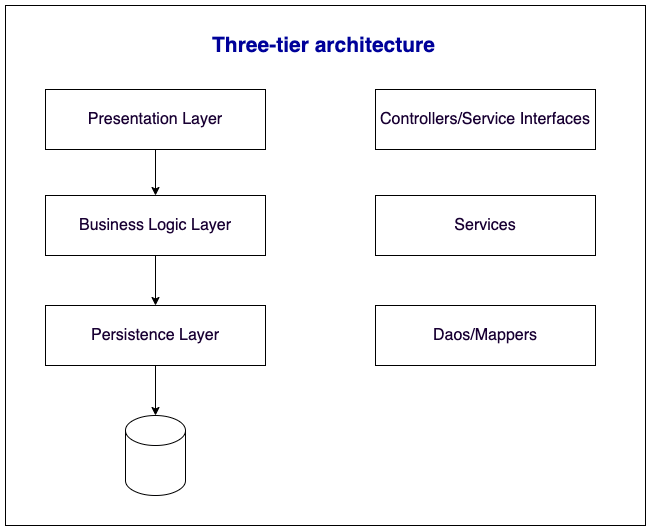
It’s a simple layered architecture. Most projects can apply it. We can integrate it with the MVC Architectural Pattern.

Why do we need architecture layers?

All logical implementations are tightly coupled in a package, which undoubtedly brings a heavy maintenance cost and has poor scalability.

The layered architecture design aims to help us achieve high cohesion, low coupling, scalable, and reusable design. We can segregate responsibilities and limit change impact within each layered. However, it is a misunderstanding that having more layers brings more benefits to a system. Fewer layers mean that a workflow traverses less logic and less overhead to do so. We need to balance the trade-off to have a practical layer design.

There are two main types of layered architectures:

  1. Strictly layered architecture, which only allows interaction with the layer below.
    • e.g. an upper presentation layer is only allowed to interact with the business logic layer below it.
  2. Relaxed layered architecture, it allows a layer to interact with any layers below it.

What should we do as architects?

As architects, we need to define standards that other engineers follow. We will need to document them and have all associated engineers’ awareness of them so that they won’t break the design during implementation. Documentations are essential here. If we only notify engineers in a verbal manner, people would forget over time and take them less seriously.

Four-tier architecture

To better fit the business and implement our domain-driven design, layered architecture design can help to highlight the benefits of the domain model concept. However, as we can see from the three-tier architecture, the database is its starting point, which engineers generally start with database modeling, and DDD’s focus is not on the database model, but on the domain model concept. It takes domain models as the basis for analysis to design architecture hierarchy.

What is the DDD solution for this?

Eric Evans provided a traditional four-tier architecture as the DDD solution in his book, Domain-Driven Design: Tackling Complexity in the Heart of Software.
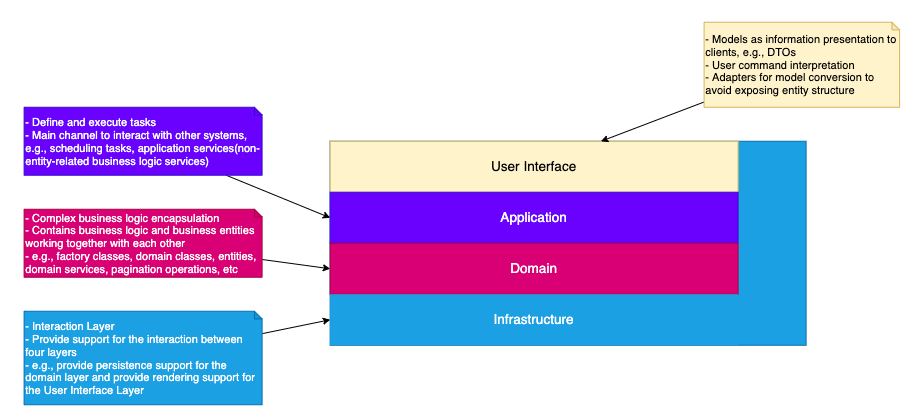
It is a Relaxed layered architecture.

We can have the following interaction:

  • User Interface –> Application, Domain, and Infrastructure
  • Application –> Domain and Infrastructure
  • Domain –> Infrastructure

Five-tier Architecture

Let’s take a look at the popular MVC Architectural Pattern.

MVC Architectural Pattern

Model–view–controller (MVC) is a software architectural pattern commonly used for developing user interfaces that divide the related program logic into three interconnected elements. 

Wikipedia

It’s highly recommended by the Spring ecosystem. However, it has certain inherent defects.

What are the problems of MVC Architectural Pattern?

  1. There’s implementation redundancy across various layers.
    • Human has the tendency to seek shortcut. MVC pattern itself doesn’t stop developers from writing business logic on Controllers, which brings redundancy across the controller layer and other layers. It is a prevalent issue that occurs during development.
    • As more logic putting into controllers, they become complicated over time.
  2. Controllers are heavily dependent on models. In terms of cross-layer interaction, Controllers are strongly dependent on services while services are heavily dependent on Daos. Models play the intermediate medium role during the interaction. This means that model prototypes need to be as simple as possible.
  3. Objects are coupled together. For example, while we send a query request to a controller, a user object is passed to an order object.
  4. It neither complies with object-oriented programming principles nor domain-driven design principles. It’s the Anemia Mode. Roles objects(referred to as domain objects in DDD) only contain get and set methods. MVC is inherently in conflict with DDD in design, where DDD emphasizes the domain concept and behavioral interaction between roles/entities.
    • MVC is more of a structural design pattern, while DDD is more of a behavioral design pattern.

What can we do to improve the MVC pattern?

The DCI(Data, Context, and Interaction) Architecture Pattern

Trygve Reenskaug, the inventor of MVC

James O. Coplien, author of Multi-Paradigm Design for C++

Trygve and James together invented and refined the formulation of DCI architecture. It’s complementary to the MVC pattern. It perfectly fits the domain-driven design.

The DCI architecture design in the above diagram has the physical separation of models and behaviors. Data objects are static objects which don’t possess any business logic and only contain the get, set, and some basic behaviors, such as sorting and pagination. It’s the Anemia Model. In addition, users’ behaviors and actions are extracted to those RoleObjs. They have a two-way binding relationship. As both a role object and a data object have their own boundaries, binding them together forms another boundary. As a result, we achieve high cohesion within the boundary.

The context layer is a simple and thin layer working as an interaction entrance. It is responsible for business scenario aggregation and carrying out interactions between contexts.

An e-commerce example of how DCI takes the benefit from both the anemia model and congestion model.

Let’s take a look at a product order workflow.

In an SOA or Microservices architecture, we generally have the order, product, and user modules for the above actions. Each of them contains related classes with some associated methods.

We normally have the following two approaches to handle this workflow:

  1. We aggregate behaviors, across several subdomains, in the current domain or specific service, e.g., a business middle platform. It’s an anemia model. Domain objects only contain some get, set, and basic methods. It’s simple and suitable for fast development.
  2. Domain models contain all associated objects’ behaviors to complete the business chain. It’s a congestion model. Domain models have lots of complicated both innate and non-innated behaviors. They might also cover some behaviors that belong to other domain models. It’s hard to define the abstract layer. As the business chain might involve interactions between several modules, data relations could be complicated, and it would be hard for us to define repositories and behavioral boundaries. It requires our dev team with robust skills and experiences in the domain and techs to manage it.

Both the anemia and congestion model have their pros and cons in scenarios like this. We can apply the DCI architecture pattern to put behaviors into those Role objects and data belonging to the same data boundaries into data objects.

Finally, we achieve the following benefits with the DCI pattern:

  1. Physical segregation and reference between Role objects and data objects to achieve high cohesion and loose coupling between data and behaviors;
  2. Resolve the issue of inconsistency between data and behaviors.

As we can see, the DCI architecture pattern is more flexible compared to the MVC pattern. It serves better for domain-driven design as it fits domain models better. We can practice domain-driven design by applying the DCI architecture design paradigm with Four-Color Modeling, an approach to analyzing requirements.

After we introduce the DCI architecture design pattern into 4-tier architecture, we have the following 5-tier architecture.

Five-tier Architecture — the derivative of the integration of the DCI architectural pattern and 4-tier architecture

It’s a Relaxed layered architecture. If business scenarios have complicated logic and interactions, we can also divide the domain layer into two adjacent layers, e.g., a transactional management layer and a context layer. The transactional management layer is responsible for the business logic chain execution while the context layer takes care of atomic action, such as a single synchronization message or roles’ interactions. As a result, we will have a six-tier architecture, which is also a variant form of five-tier architecture.

Six-tier Architecture
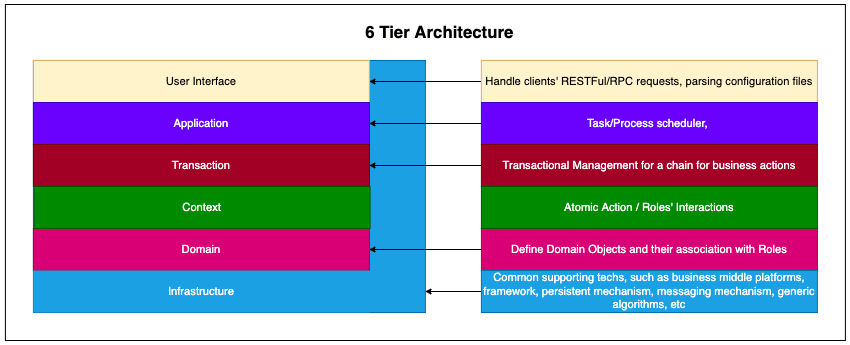
It is also a Relaxed layered architecture.

However, we might encounter system breakdown if there is infrastructure failure occur where no matter whether our architecture is strictly layered architecture or relaxed layered architecture. Also, in a strictly layered architecture, the upper layers break down if the layers below them malfunction.

How can we solve this problem?

We can apply the Dependency Inversion Principle to resolve this issue. The upper layers shouldn’t depend on the concrete implementation of the lower layers. Instead, they should rely on lower layers’ abstractions or interfaces. Also. the concrete implementations should also depend on abstraction.

There’s a more elegant architectural style, i.e., Hexagonal Architecture.

Hexagonal Architecture
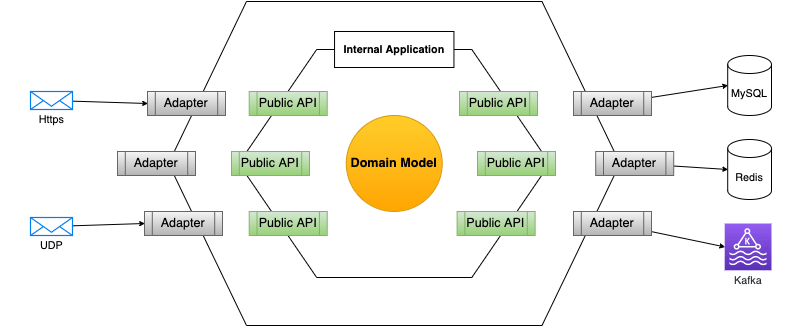
Alistair Cockburn, one of the initiators of the agile movement in software development, invented the Hexagonal Architecture.

We can also call it ports and adapters architecture. It is a strictly layered, highly cohesive, and flexible architecture.

Features:

  • Domain Model: Core business logic
  • Public APIs: The internal application exposes public APIs for outer layer usage.
  • Two types of Adapters:
    • Driving Adapters are responsible for clients’ inbound requests.
    • Driven Adapters are responsible for outbound interactions, e.g., interaction with a Redis cluster.
  • Each adapter is paired with specific usage. (Single Responsibility Principle)
  • Interactions are strictly through APIs but not code implementation, i.e., concrete application layer implementation must not occur in the domain model.

Conclusion

We’ve looked at features of various architectural styles.

Again, we use technology to empower business. Tech is supposed to be driven by business requirements, and so do architecture design. Having more tiers doesn’t mean it’s better to serve our software system and development. We should design software architecture based on business scenarios. We need to consider the trade-off between the clear responsibility of multi-tier architecture and its cost. We need to avoid over-design.

If you are interested in DDD, I suggest you also take a look at four-color modeling and event storming.

If I have time, I might write more articles about other architectural styles and how we practice DDD with implementation and project structure.

If you have any career or business opportunities to share with me, please contact me through LinkedIn.

DDD(Domain Driven Design)-3 Key elements of DDD

In the previous post, I discussed the Domain and Subdomain concepts of DDD and what we need to avoid when we define them.

To better elaborate on my next post regarding various software architecture styles and how we can integrate DDD with some of them, I will explain the critical concepts of DDD in this article.

Ubiquitous Language

Ubiquitous Language is the Domain-driven design term that describes common, rigorous language that developers and stakeholders share within specific boundaries.

It helps teams develop standardized terms and language so that all stakeholders have a consensus. It aims to assist us as product managers/owners, QAs, developers, and architects in accurately expressing business and understanding requirements.

I used to work for a telecom company, and my project has the term MVP. MVP generally stands for minimal viable product, but within our project scope, it refers to managed voice platform. It will bring confusion if we don’t clearly define it. That’s why we need Ubiquitous Language.

Bounded Context

Bounded Context is the boundary within a domain where a particular domain model and ubiquitous language apply. It is the central pattern of DDD that helps us avoid ambiguity and uncertainty in our software development.

Domain Model

Domain model is a structured visual representation of interconnected concepts or real-world objects that incorporates vocabulary, key concepts, behaviours, and relationships of all its entities. 

In a business logic implementation, a domain model is presented as a business object model, which describes the interconnected relationship between our business objects.

Business Objects(BO)

A BO model generally has 3 main components: business roles, business entities, and business use-case.

Business Roles: The roles play in our projects/systems, possessing inherent properties and a series of responsibilities, e.g., E-commerce customer service staff responsible for answering sale inquiries, order management, refund, product return, etc.

Business Entities: The components that are necessary for business roles’ interaction, e.g., product and invoice in an E-commerce project.

Business use-case: The workflow that business roles and business entities work together to execute, e.g., the action chain of product searching, product browsing, ordering, payment, deduction from inventory, invoicing, and delivery.

These 3 components together form a business object model.

4 categories of domain models

Blood Loss Model

  1. Classes with only get and set without other logic, not even a simple sorting method.
  2. Pros: It has a simple structure.
  3. Cons:
    • It is hard to maintain with inflated business logic
    • It is hard to satisfy frequent changing requirements as it doesn’t have the Dao layer. All logics, including implementation code associated with JDBC invocation, reside in the service layer.

Anemia Model

  1. Classes added atomic domain logic based on the Blood loss model, such as sorting and pagination methods.
  2. Classes have attributes and innate behaviors/methods(i.e., belong to the domain model without persistence needs).
  3. Other logic or non-innate behaviors that require database interaction resides in the business logic layer.
  4. It is the recommended model by the Spring ecosystem.
  5. Pros:
    • It has a clear layer structure.
    • It has single-direction dependency across layers.
    • It is easy to understand and brings fast development benefits for applications with smile business logic.
  6. Cons:
    • It can’t gracefully cope with highly complicated logic and business scenarios.
    • It has low cohesion in projects’ core domains.
    • It doesn’t comply with some object-oriented programming principles.

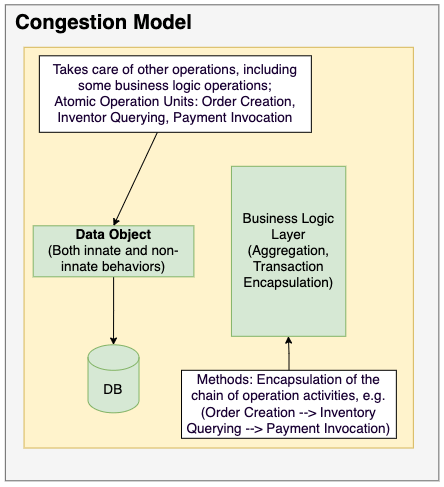
Congestion Model

  1. It is more in line with object-oriented programming principles than the Anemia model.
  2. Domain objects contain both inherent and non-inherent logic. The business logic layer is only responsible for consolidation operations and transaction encapsulation, while domain objects take care of other operations.
  3. Pros:
    • It has a thinner business logic layer, which is more in line with the single responsibility principle.
    • The business logic layer doesn’t interact with the Dao layer.
  4. Cons:
    • It requires engineers to have robust implementation and design skills because it’s difficult to distinguish whether we should put specific business logic in the business logic layer or domain objects in particular scenarios.
      • We will need to write business logic to domain objects in some scenarios. Unfortunately, it could lead to cascading errors if we create some bugs during the process.
    • A higher cost to hire better engineers compared to using the Anemia model is one of the main reasons the Anemia model is more popular.
    • It has a higher instantiation cost, as many operations reside in the domain model.

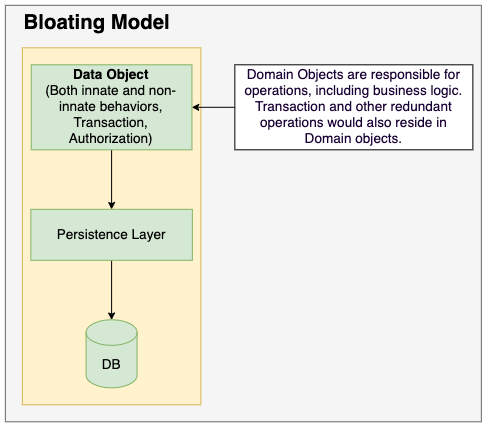
Bloating Model

  1. It has a simple layer structure.
  2. There’s no service layer in the bloating model, only domain objects and Daos.
  3. Domain objects and their methods take care of transactional operations, authorization, etc.
  4. Pros:
    • It has a simple architecture layer.
    • It complies with object-oriented programming principles.
  5. Cons:
    • As domain objects contain business logic and many other responsibilities, the code maintainability is terrible.
    • As domain objects’ domain logic takes care of transaction encapsulation and authorization, it contains some logic that does not necessarily belong to the domain objects causing greater code complexity compared to other models.
    • Engineers might need to refactor and redesign the domain model over time as increased requirements changes would cause logical chaos and unstable domain models.

Decision-Making Overview

The Anemia model is the most popular model which Spring ecosystem recommends. In contrast, the Congestion model has higher requirements for the dev teams, better system cohesion, and is suitable for businesses with straightforward business logic, such as businesses in the insurance industry.

Preview of next post

My next blog post will discuss the features, pros, and cons of the MVC architectural pattern, 3-tier architecture, 4-tier architecture, 5-tier architecture, hexagonal architecture, and more. After the discussion, I will elaborate on the architectural pattern solution that can gracefully integrate with the DDD approach.

See you in my next post.

DDD(Domain Driven Design)-2 Apply DDD to design microservice architectures that genuinely satisfy our business evolution needs

This is a subsequent post of

How does DDD help us define business domain and model boundaries?

There are mainly two phases to achieve this. Here is a brief summary:

Strategy Design Phase:

  1. Architects, product managers/owners, and operation staff are responsible for this phrase.
  2. They start from the business perspective and circle around the business boundaries to define the domain models, domain boundaries, and bounded Context(i.e. the business boundary of microservice).

Tactical Design Phase:

  1. Business logic developers are responsible for this phrase.
  2. They start from the technical perspective and execute implementation according to outputs, such as domain models, from the strategy design phase.

Strategy Design

Domain — the scope of critical problems our system’s core business wants to solve

In DDD, we plan, execute, and resolve problems within the scope.

We can take a domain as a problem domain. Therefore, once we define the domain for the system, we already have the problem scope boundaries for our system’s core business.

It is the boundaries about what problems we solve, what we will do, to what extent, etc.

SubDomains

As a domain is a scope of wrapping critical problems together, they are big and we need to divide and conquer these problems to make things less complicated and more manageable. Hence, we have subdomains to achieve it.

There are three types of subdomains:

  1. Core subdomain — the must-have components of our system
  2. Generic subdomain — the share components of our system, similar to common.jar of our Java project
  3. Supporting subdomain — the nice-to-have components of our system, e.g. coupon service of a traditional e-commerce website.

Core subdomain

they are the most critical and most competitive subdomains of the system. They are the components that our business can’t live without.

To define core subdomains, we must understand the core value of our business. This leads to the domain vision statement. Take Alibaba as an example, its mission is to make it easy to do business anywhere. Their core value is trade empowerment. Components associated with it, such as the merchant system and transaction system, are the core subdomains.

Generic subdomain

They are the subdomains that other subdomains within the domain would like to use. The IAM(Identity and Access Management) module is one of the typical examples of it.

Supporting subdomain

They are neither core nor common features but essential in specific business scenarios. For example, coupon and last-minute trade modules are essential to particular workflows of a traditional e-commerce system, but the system can still work well without them.

Why it is a bad idea to copy domain models from similar businesses?

Let’s compare Alibaba Taobao and JD.com.

Both of them are e-commerce giants in China. However, Taobao is the premier C2C online marketplace in China while JD.com has a B2C business model. Their products have many common features.

However, copying domain models from each other would bring fundamentally wrong.

Taobao’s focus is trade empowerment while JD.com focus on quality and brand reputation.

Alibaba’s mission statement is to make it easy to do business anywhere. It invests the majority of its resources in facilitating trading between buyers and sellers. It’s the core value for the business to survive and thrive. Double 11 festival and Taobao Live are typical examples to express their core value. Ordering and merchant systems are its core subdomains.

On the other hand, JD.com dedicates most of its resources to ensuring product quality and protecting and promoting branding. JD’s delivery is super fast. It provides same-day delivery in some cities and next-day delivery in others. Not only the delivery service is fast and provides a better user experience, but it also ensures the product’s quality until the last moment before handing it to customers. Therefore, supply chain, procurement, warehousing, and delivery are all critical domains.

As they have different business models, their focuses are different. It leads to the divergence of software design and domain model design. Hence, copying models from other similar businesses wouldn’t be wise. It is also the main reason that we will need our architects to have in-depth domain knowledge to have the competence to design an ideal architecture.

Conclusion

We have looked at the Strategy Design and things to avoid when we define our domain models. In the following blog articles, I will explain more DDD concepts, such as domain models, various implementations, the pros and cons of different architecture models, and how we apply DDD to our architecture design.

Featured

DDD(Domain Driven Design)-0 architecture design with DDD

Technology empowers business. Most Internet companies are Business-Outcome-Driven Enterprise, where business determines the technology adoption, architecture adoption, and service boundaries. Most projects on the market cannot reflect the professionalism of software architecture design. We need a practical methodology to solve this problem, and DDD is an ideal formula.


DDD is a software architecture design methodology that facilitates engineers/architects to understand the business better and design tech solutions that satisfy changing business requirements. I’m about to write a series of blog articles to elaborate on this methodology. These articles cover architectural decision dilemmas, common misunderstandings about DDD, how we address these problems, DDD basic concepts, elaborate on the pros and cons of various architecture in detail, architecture design that complies with DDD practice, etc.

Directory

DDD(Domain Driven Design)-1 Apply DDD to design microservice architectures that genuinely satisfy our business evolution needs

Microservice boundary definition dilemma

Defining the boundary of services is inevitable regarding microservice architecture design. How micro does a service have to be to be considered a microservice? What are the ideal boundaries of services that can meet changing business requirements? What are the differences between SOA and microservices?

Many engineers claim that they work on microservices but apply the SOA approach.

Service-oriented Architecture(SOA) VS Microservice

SOA focuses on service reusability and resolves the information silos issue.

Microservices emphasized higher service granularity, service decoupling, and scalability.

From the above definition, it is evident that SOA has a more coarse-grained service partitioning compared to microservice.

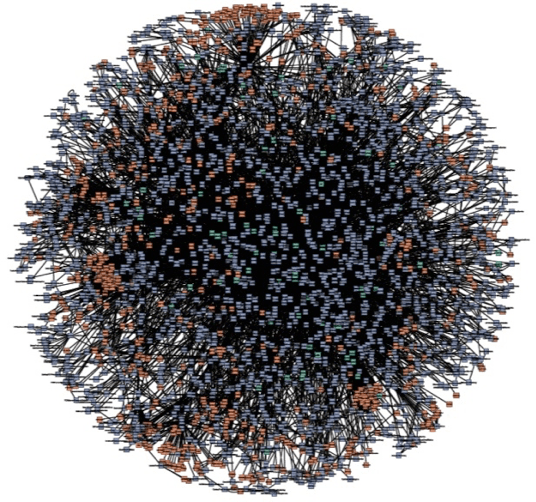
Oversized services inevitably introduce certain redundancy, relatively poorer resource isolation, and loses some of the microservice’s benefits, while over-decomposed services bring service governance and operational difficulties. Imagine the nightmare of managing thousands of microservices for the latter case.

Microservices structure at Amazon

Therefore, we will need an approach to define the boundaries, modeling and etc.

What is the problem with starting with data modeling?

physical data model is a database-specific model that represents relational data objects. It couples with requirements. Requirements changes would cause data model changes, and the internet industry is rapidly iterating. We can expect that physical data models are no longer suitable for the business workflow if they are unthoughtfully defined. We will need something more conceptual, like context boundary, architecture design, specification, etc.

So, what approach can help us to design microservice architecture?

Define the domain model, divide the domain boundary, and then carry out the micro definition of microservices according to the outcome. As a result, the business and technical boundaries are reasonable, achieving high cohesion and loose coupling, which is the ideal state of microservices.

DDD is the formula to achieve the above outcome.

What is Domain Driven Design(DDD)?

Domain Driven Design(DDD) is an effective software design approach focusing on modeling software based on business-expert-defined business domains.

While it brings a great benefit to our software design, it has certain difficulties to implement it.

Before jumping into how to do it, the following sections will elaborate on what is required to apply the approach, why it is hard to implement it, and common mistakes we need to avoid.

What is required to apply DDD?

The crucial components in DDD are business models. Defining ideal business models requires us to have an in-depth understanding of our businesses. It brings difficulties to implement it.

Why are the difficulties to implement DDD?

  1. It requires architects to have rich experience in business domains and related techs.
    • Architects from other industries might not be able to define proper domain models.
  2. It requires each role in the team to have a considerable degree of professionalism to implement it.
    • Tech experts must be able to assist architects in completing the logical design phase; otherwise, the project will stall.
    • To implement it, all parties, including technical managers, technical experts, and developers from various levels, must be able to understand well-defined diagrams, such as conceptual diagrams.

If the project doesn’t have a particular volume and the company’s business model doesn’t have a robust business model, practicing such a design would lengthen the entire development cycle. This is because completing the holistic design following the approach consumes an obnoxious amount of time. The early conceptual design and the logical design phases are time-consuming. Many companies, especially startups, do not resources(e.g. time, experts, etc) to follow a standardized approach like this. Even worse, some startups’ core business domain varies frequently over time, and it will cost more resources to make adjustments.

However, it is still valuable to integrate multiple software design methods and DDD to formulate a design approach suitable for the scenarios of your projects and to construct solutions for complex business requirements. I am going to elaborate on how we do it later. Let’s start with some basic concepts.

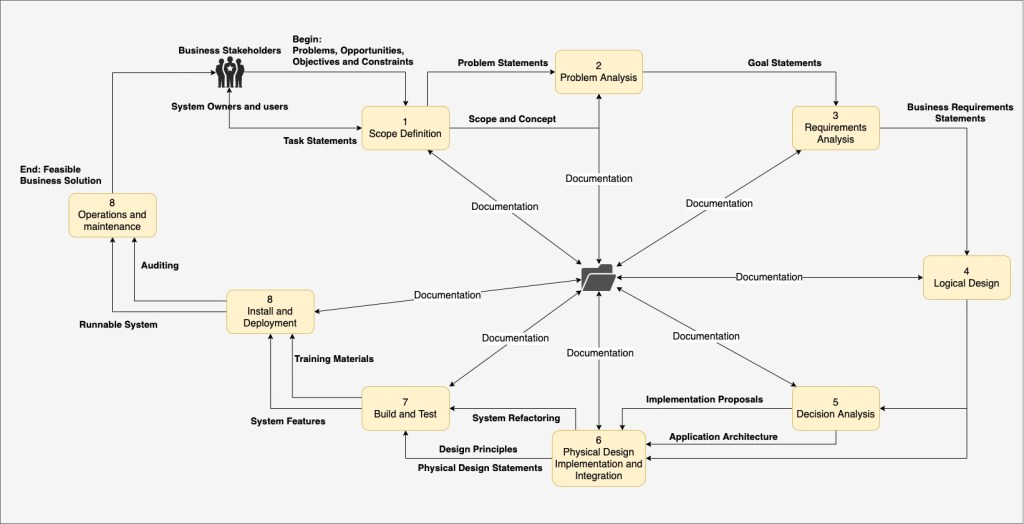
Three phases to practice DDD

  1. Conceptual design (scope definition)
    • From stages between 1 to 3 in the above diagram, architects, product managers/owners, and operations staff work together to produce concept diagrams, concept classes, domain class diagrams, etc.
  2. Logical Design
    • Senior devs(e.g., tech lead, tech experts, senior developers, core developers, etc.) work with architects to do modeling according to the first step’s outputs. These outputs are business-modeling-related documentation and diagrams, such as use case diagrams, use case specifications, use case scenarios, use case views, business object models, etc.
  3. Physical Design
    • Developers work together to implement the requirements. They fix some emerging issues that they haven’t considered in previous steps. For example, some performance issues might require them to adjust models.
    • Developers and architects decide how to store data(e.g., indexing, read-write segregation, partitions, etc.).
    • Developers and architects define architecture software architecture styles(e.g., microservice, RESTful architecture, etc.)
      • We will know whether our models are suitable for microservice or not till this point.

Conclusion

We’ve looked at why we need DDD and three major phases in this blog article. In my next post, I will explain how DDD helps us to determine business domain and model boundaries, basic concepts of strategic design, and why copying models online or similar business is not a good idea.